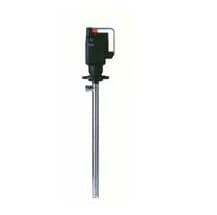
Brand: Lutz
Lutz Standard Electric / Air-Operated Drum Pumps: Pump Tube Material and Impeller Selection
Updated: 2026-09-04
Lutz standard drum pumps use a modular motor-and-tube design. Pump tubes come in PP, PVDF, aluminium, 316 stainless steel and Hastelloy C, in mechanical seal (MMS) or sealless (MSL) versions, with axial rotor or radial impeller for flow or head.
Selection support
- Share flow rate, pressure, medium, temperature and material requirements.
- We can support pump selection, dosing package configuration and spare parts matching.
- Detailed English datasheets and quotations are available for priority models on request.
Technical details
A Lutz standard drum pump is essentially an immersible centrifugal pump: the pump tube goes into the drum and is driven by a motor on top. Its defining design feature is modularity — motors and pump tubes are purchased separately, and all Lutz motors are interchangeable with all Lutz pump tubes. One motor can therefore serve tubes of different materials and lengths, which materially reduces equipment cost in a plant handling several media.
The pump tube itself is non-lubricated, so no lubricant can contaminate the pumped liquid — a hard requirement in food, pharmaceutical and high-purity chemical service.
1. First: select the tube material for the medium
| Tube material | Positioning | Typical media | Flammable liquids? |
|---|---|---|---|
| Polypropylene (PP) | General acids and alkalis | Acids, alkalis, vegetable oils, phosphates, sulphates, nitrates, chlorates, paints and inks, water | No |
| PVDF | Concentrated corrosives | Highly concentrated acids and alkalis, 95% phosphoric acid, perchloric acid, chromic acid, sulphuric acid, hydrofluoric acid, nitric acid, chlorine water, chloroform | No |
| Aluminium | Neutral liquids | Mineral oils, cooling lubricants, diesel fuel, fuel oil, crude oil, glycerine, fatty acids, butylene glycol, paraffin oil | No |
| 316 stainless steel | Flammable and aggressive liquids | Gasoline, solvents, alcohols, amines, benzoles, phenols, toluol, xylol, acetone, ether, freon, methylene chloride, fruit juices | Yes |
| Hastelloy C (HC-4) | Extremely corrosive duty | Bromine, chlorosulphonic acid, butyl chloride, chlorine water, and nearly all kinds of liquids | Yes |
The critical column is the last one. The manufacturer's literature explicitly states that PP, PVDF and aluminium tubes must not be used for flammable liquids — that is a safety prohibition, not a performance preference. Gasoline, solvents and thinners require a 316 stainless steel or Hastelloy tube; combined with original Lutz Silver Star, MD-1 or MD-2 motors these tubes are Zone 0 approved (see also the explosion-proof drum pump).
2. Second: mechanical seal (MMS) or sealless (MSL)
| Item | MSL sealless | MMS mechanical seal |
|---|---|---|
| Shaft sealing | Drive shaft unsealed; the bearing housing behind the impeller prevents liquid rising along the shaft and guides any ingress back into the container | Single-acting mechanical seal integral with the lower bearing housing (patented), positioned for best operating conditions and seal life |
| Seal materials | None | Carbon, SiC, Viton, HC-4 |
| Bearings | PTFE (PP / PVDF tubes) | PTFE (PP / PVDF tubes) |
| Dry running | Structurally more tolerant | Must not be run dry |
| Maintenance | No seal wear parts | Seal is a wear part requiring periodic inspection |
The logic is straightforward: where operators may empty the drum completely, or where the pump starts and stops frequently, choose MSL — a mechanical seal is destroyed by dry running, which is the single most common cause of drum pump failure. Choose MMS where leak-tightness matters more, or where the medium is expensive or toxic.
One point deserves separate mention: the aluminium MSL tube is explicitly documented as designed to run dry, making it the most forgiving option in the range for sites with high staff turnover or where operating discipline is hard to guarantee.
3. Third: axial rotor or radial impeller
This choice is the most frequently overlooked, and it decides how usable the pump actually is. Each tube is available with two impeller types, and the manufacturer's rule is:
- Axial-flow rotor — high delivery rate, low delivery head. Suited to emptying a drum quickly into a container alongside it, with short pipework and no lift.
- Radial-flow impeller (L) — low delivery rate, high delivery head. Suited to lifting liquid to an upper floor or elevated tank, or to long, high-resistance discharge lines.
The difference is substantial: on the same motor, the rotor type delivers roughly twice the flow of the impeller type, while the impeller type produces roughly twice the head. The classic mistake is specifying the rotor type for "maximum flow", then finding the flow collapses as soon as a long or raised discharge line is connected. Establish the required lift and line length first, then the required rate.
The radial impeller version also tolerates higher medium viscosity than the axial rotor, so thicker media likewise point to the impeller type.
4. Motor selection
All Lutz motors combine freely with all Lutz pump tubes; choose according to site conditions:
- Universal electric motors: the standard configuration, some with speed control, for fixed workstations.
- Explosion-proof electric motors: for classified areas, paired with stainless steel or Hastelloy tubes.
- Air motors: inherently safe, infinitely variable in speed, and immune to burn-out on stall — ideal for flammable duty and frequent starts, given a stable compressed air supply.
- Three-phase gear motors: for high-torque, continuous operation.
- DC motors: battery powered, for mobile work without mains supply.
5. Immersion depth
Pump tubes are available in several standard lengths, commonly covering roughly 700 mm to 1600 mm (the available lengths vary slightly by material), with special immersion depths available on request. Select against the actual container depth: too short and residual liquid cannot be reached, too long and the tube will not fit a small drum. Where a drum must be emptied completely, dedicated complete-drainage pump tubes are available.

Selection checklist
- Is the medium flammable? Yes → 316 stainless steel or Hastelloy tube only, with an explosion-proof or air motor.
- How corrosive is it? General acids and alkalis → PP; concentrated acids → PVDF; neutral mineral oils → aluminium; extreme corrosion → Hastelloy C.
- Might it be run dry? Yes → MSL sealless (the aluminium MSL is the most tolerant); no, and tight sealing needed → MMS.
- How high and how far must it pump? High or long → radial impeller; low, short and fast → axial rotor.
- How deep is the container? Select tube length accordingly.
Above roughly 500 cps a centrifugal tube is no longer suitable and a screw type is required (see the HD-E medium-viscosity screw pump and high-viscosity screw pump). Add a TR / TS flow meter where dispensed quantities must be measured. See the drum pump range overview for other series.
Technical points on this page are compiled from the Lutz product literature "Electric/Pneumatic Drum and Container Pumps". Flow and head figures for a specific model depend on the motor fitted; please confirm with our engineers before ordering.