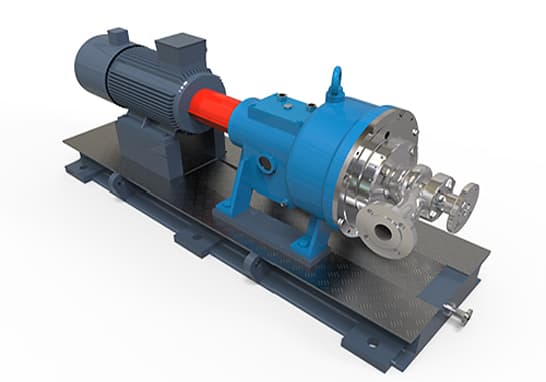
Pitot Tube Pump
Updated: 2022-08-22
HXK rotating-casing (pitot tube) pump delivering up to 110 m³/h at heads up to 1900 m and design pressure up to 25 MPa, a high-efficiency, long-life alternative to high-speed and multistage pumps for power-plant feedwater, paper-mill high-pressure spray and petrochemical process duties.
Selection support
- Share flow rate, pressure, medium, temperature and material requirements.
- We can support pump selection, dosing package configuration and spare parts matching.
- Detailed English datasheets and quotations are available for priority models on request.
Technical details
Overview:
The HXK rotating-casing pump, also known as a pitot tube pump, is a completely new concept of pump in which the impeller, rotor cover and casing rotate synchronously with the liquid. It was developed after breaking through three challenges in novel theoretical analysis, design and manufacturing. Its drum, rotor cover and impeller drive the liquid to rotate synchronously, eliminating the large disc-friction losses found in conventional low-flow, high-head centrifugal pumps such as high-speed pumps and multistage pumps, and thus achieving a much higher efficiency than those pumps. At the same time, because the seal is exposed only to inlet pressure, seal life is long; the bearings carry only very small axial and radial forces and are not contaminated by leaking media after a seal failure, so bearing life is also long. The performance curve rises continuously from maximum flow to shut-off, giving smooth hydraulic performance. The only wear parts are the mechanical seal and the O-rings, so spare parts are few, maintenance costs are low, and interchangeability is high. With its compact structure, high efficiency, long life and ease of maintenance, it is a high-tech product that replaces high-speed pumps and multistage pumps.
Structural diagram of the pitot tube pump:

- Inlet pipe (connector)
- Mechanical seal
- Outlet pipe (for side-in/side-out arrangement)
- Drum cover (impeller)
- Collector pipe (pitot tube)
- Drum
- Main shaft
- Bearing housing
- Protective cover
Structure:
The pump consists of a rotor, a collector pipe, a bearing-housing assembly, an outer casing, and inlet/outlet pipes. The bearing-housing assembly is the same as that of a conventional centrifugal pump. The wetted impeller and rotor chamber are connected into one piece and bolted to the main shaft to form the rotor assembly. The rotor chamber is surrounded by an outer casing for protection, bolted to the bearing housing. The inlet and outlet pipes are fixed to the right end cover of the outer casing. The core component — the collector pipe — is fixed to the outlet pipe and extends from the axis to near the inner cylindrical wall of the rotor chamber. The pump has a mechanical seal only between the impeller inlet and the inlet pipe, sealing the low inlet pressure of the pump.
Working principle:
The liquid to be pressurized enters the impeller from the inlet pipe and gains kinetic energy from the high-speed rotation of the impeller. The liquid moves axially from the impeller periphery into the outer region of the rotor chamber, then enters through the inlet of the collector pipe located at the outermost periphery of the rotor chamber. Because the cross-sectional area of the collector pipe gradually increases, the liquid velocity gradually decreases, converting the kinetic energy of the liquid into pressure energy. Finally, the high-pressure liquid is discharged from the outlet pipe. Because the impeller and the rotor chamber are joined into one unit and rotate synchronously, there is no disc-friction loss while the liquid acquires kinetic energy — this is the fundamental reason why this new pump is far more efficient than high-speed pumps and multistage centrifugal pumps of the same low specific speed.
Features and advantages:
Based on its unique pump theory and special manufacturing methods, the pitot tube pump offers the following features:
- High efficiency, low operating cost. The rotating-casing pump is more efficient than a high-speed pump of the same flow rate and head, reducing pump operating costs.
- High reliability, low maintenance cost. The low-pressure-end seal design, together with the small radial and axial forces on the rotor, increases the service life of the mechanical seal and bearings. There are few wear parts and they are easy to install and remove, reducing maintenance costs.
- Lower initial investment. Under low-flow, high-head conditions, the rotating-casing pump has a clear cost advantage.
- Convenient flow regulation. The head-flow curve of the rotating-casing pump is flat, with no "hump" characteristic typical of low-specific-speed centrifugal pumps, so the flow rate is easy to adjust and operation is stable at different flow rates.
- Low spare-parts cost. The rotating-casing pump series has few wear parts, and parts have high commonality and interchangeability, reducing spare-parts inventory costs.
Performance parameters:
| Parameter | Value |
|---|---|
| Flow rate | ~110 m³/h |
| Head | ~1900 m |
| Speed | 2950–6800 r/min |
| Design pressure | ~25 MPa |
| Operating temperature | -40°C to 288°C |
Application scope:
- Power generation: cleaning pumps, fuel pumps, boiler feedwater pumps
- Paper industry: high-pressure spray, high-pressure jet
- Petrochemical: process pumps, hydrocarbon-liquid transfer, waste-liquid transfer
- Other industries: other applications using high-speed pumps and multistage pumps